| ℹ️ It is essential to keep in mind that the responsibility for implementing the necessary infrastructure or servers corresponds to whoever contracts the Voice solution. |
Find out below the workable options to use 
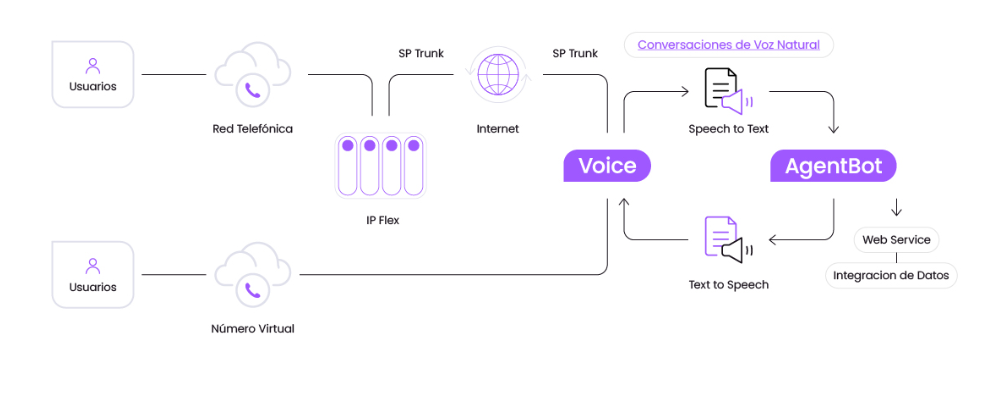
1. Own IP telephony platform: in this possibility, you need a central office that supports the SIP protocol, as it is essential to set up communication (through a SIP Trunk) between your local IP telephony infrastructure and Voice.
It is key to note that although Voice has no limits on the number of simultaneous calls, this will depend on the bandwidth allocated for the SIP connection and the methods used to set it up.
 Here you will find more information about SIP protocol.
2. Virtual number: If you do not have an IP PBX with SIP support, you can use a virtual phone number from your geographic area or country to access the Voice service.
This phone number is not physically associated with a specific phone line but is instead sent to another number or device and can be used as a choice to activate the voice channel and allow communication with customers. Please note that there may be a variable associated cost depending on the country of the said number.
If you advance with this choice, you can channel it directly with Aivo.
 Key Data:
- If the connection is via Sip Trunk, it will be possible for the first contact to be the IVR and then move on to Voice, or for the first contact to be Voice directly.
- In the virtual number connection method, the first contact can be Voice or your IVR. However, if the number is kept by you as a customer, it will go through your IVR first.