This material is intended to help you understand how the Autogenerated Knowledge feature works and how the Prompt affects it. Below, we cover key points about this topic. We recommend reading them in the order shown to better understand the full process.
 Before using Autogenerated Knowledge:
- Keep in mind that this feature is available only with the new conversational engine.
- You must add and process the content.
 Recommended reading:
- Enable Autogenerated Knowledge by Generative AI
- Incorporate the content of PDF files into Autogenerated Knowledge with Generative AI
- New conversational engine
- Best practices for managing your Autogenerated Knowledge with Generative AI
How does Autogenerated Knowledge work?
After you add content to the Autogenerated section in Virtual Assistant—either from links or PDF documents—and enable the option to use that content, a customer’s query to the Virtual Assistant first triggers a search in Personalized Knowledge. If the answer is not found there, the system searches Autogenerated Knowledge.
 Observe the complete process in the diagram below:
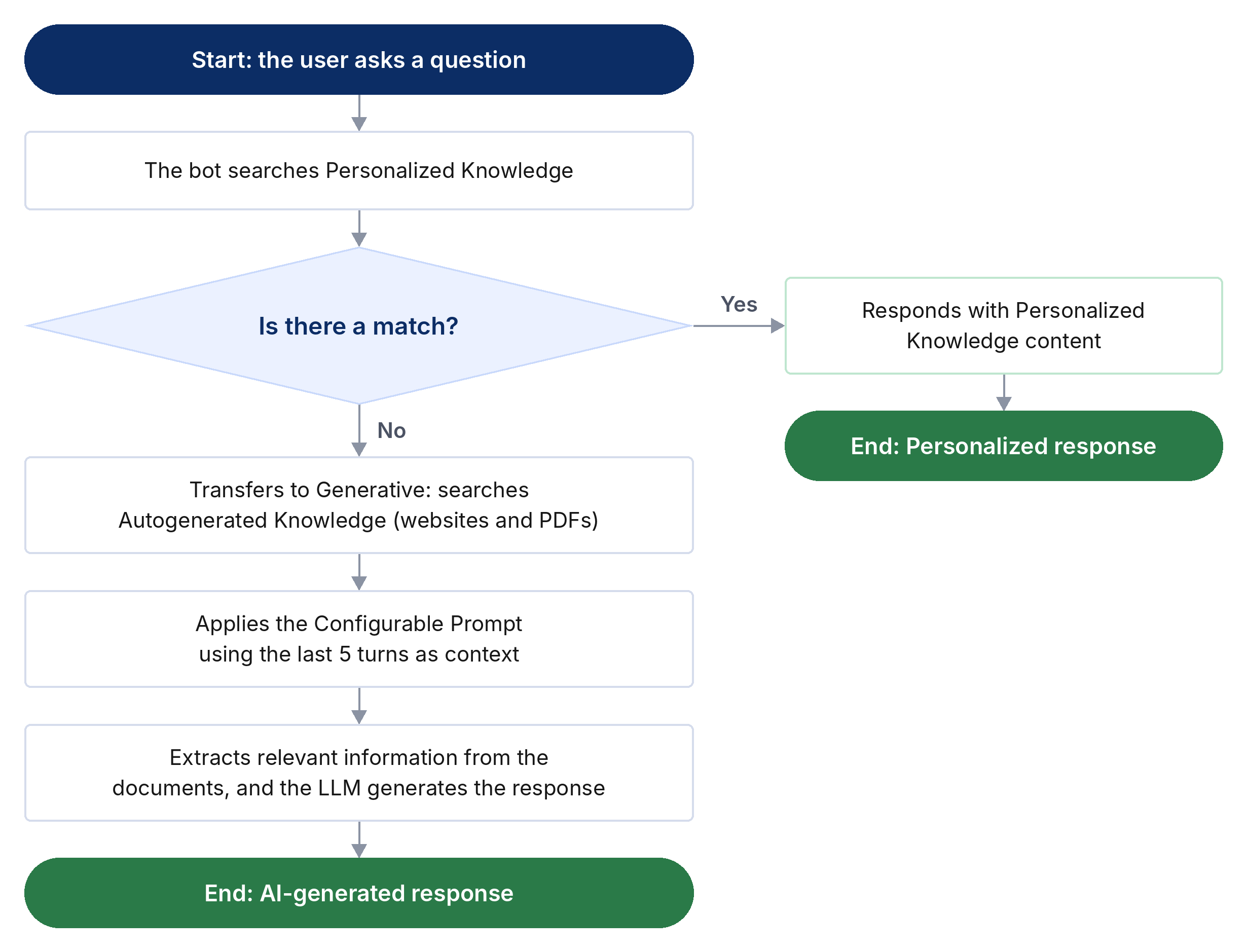
1. The system searches Personalized Knowledge first. If it finds an answer, it provides it and ends the process.
2. If it does not find an answer, it searches Autogenerated Knowledge using the websites or documents that were added.
3. When suitable content is found to generate the reference answer, it is processed using the Configurable Prompt instruction.
4. The information is inserted as context. Generative AI uses the last 10 messages/interactions in the conversation history (5 turns) as context, regardless of whether they were exchanged with the Virtual Assistant, a Live human agent, or an integrated external service such as Genesys.
5. The system extracts relevant information from the content, and Generative AI generates the response.
 The Configurable Prompt affects responses based on Autogenerated Knowledge. The next section explains what a Prompt is and its scope.
About the Prompt in the virtual assistant What is a Prompt in general?
A Prompt is the instruction, context, or set of guidelines given to an AI system to guide how it generates responses. It is written in natural language and can be as simple as a sentence or as detailed as several paragraphs.
A question is not the same as a Prompt: a question seeks an answer, while a Prompt shapes the interaction and guides the AI toward an expected result. Official Prompt and Configurable Prompt
The Official Prompt is the set of predefined instructions that guide the assistant’s personality and general behavior. The Configurable Prompt lets you add specific guidelines and only applies when the assistant responds using Autogenerated Knowledge. It complements the Official Prompt; it does not contradict or replace it. Prompt priority
When the assistant responds, the Official Prompt takes priority in determining how it responds because it is configured to provide broad, general answers. If a specific adjustment is needed for an area of interest or a particular context, you can add a Configurable Prompt. It complements the Official Prompt and applies only to responses based on Autogenerated Knowledge. Recommended reading:
- Criteria that can be adjusted in the Configurable Prompt
- Diagnosing prompts in virtual assistants: Before adjusting the prompt, identify the instance
Key facts and limitations of generative models
- An LLM (Large Language Model) is an artificial intelligence model based on deep learning. It is trained on enormous amounts of text to understand, process, and generate natural language. Its goal is to interact with people naturally and handle tasks that previously required human intervention.
- How does it work? LLMs use an architecture called "Transformer", which lets them analyze the full context of a text and understand relationships between words and concepts. They work by predicting the most likely next word in a sequence, generating responses that are coherent and adapted to the context.
- They can also perform new tasks based on instructions (Prompts).
- LLMs are nondeterministic models: the same query can produce different responses. Prompt instructions guide the result, but do not guarantee that the model will follow every instruction in the same way in every case.
This variability should also be considered when configuring derivations or transfers, integrations, buttons, and other complements. The model generates text; the platform then interprets certain internal tags to perform the associated actions.
 If you have further questions, please consult your CSM or contact us through our Support Center.